

Additional Shipping Container Information
SCS International is now an affiliate reseller of new and used shipping containers/conex boxes, shipping container doors and parts! For more information, please contact us or browse on Amazon/eBay:
- Get a Quote for Shipping Containers
- Shipping Container Doors | Buy on Amazon or eBay
- Shipping Container Lockbox | Buy on Amazon or eBay
- Shipping Container Cam Keepers | Buy on Amazon or eBay
- Shipping Container Lock Rods | Buy on Amazon or eBay
- Shipping Container Door Handles | Buy on Amazon or eBay
- Shipping Container Rubber Gaskets | Buy on Amazon or eBay
- Shipping Container Hinge Pins | Buy on Amazon or eBay
Shipping Container Door Diagram and Troubleshooting
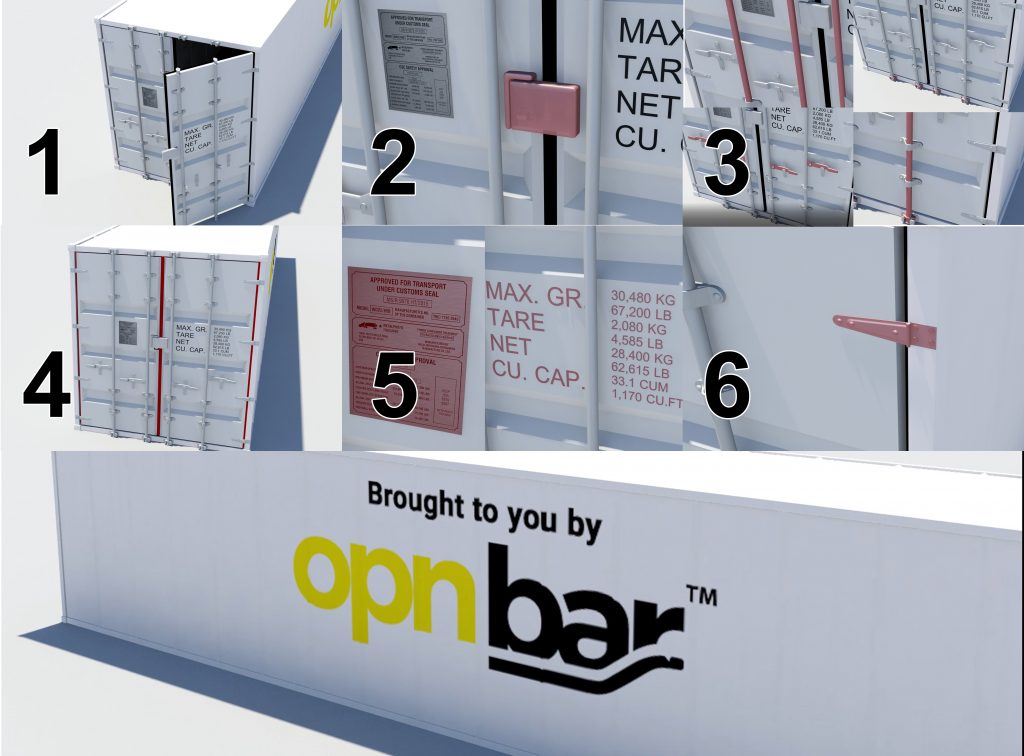
Shipping Container Diagram
1. Doors
Two door leaves are fabricated from two vertical rolled hollow sections and 2 horizontal c section members. The frame is infilled with corrugated steel paneling.
These are normally attached to the rear corner posts each with four drop forged steel hinge blades. The blades allow 270 degree opening which allow the doors to swing back against the container side wall.
(Cargo may shift during transit. Look at the container to make sure that the doors are aligned and level, both top and bottom. In cases where the container frame is racked and the door gear will not operate correctly.)

Shipping Container Door
- Shipping Container Doors | Buy on Amazon or eBay
2. Lockbox
The lock box is a steel box welded to the right hand door which overlaps a staple welded to the left hand door. A padlock, normally type CISA type 285 66 can then be attached inside the lock box through the staple and is then protected from direct attack, hindering attempts to gain entry to the container.

Shipping Container Lockbox
- Shipping Container Lockbox | Buy on Amazon or eBay
3. Lockrods, cam keepers, handles
Each door is fitted with 2-4 vertical lock rods to enable opening, closing and locking of the doors.

Shipping Container Lockrods
- Shipping Container Lock Rods | Buy on Amazon or eBay
At the end of each lock rod (top and bottom) is a cam welded in place which engages with knuckles, also known as cam keepers.

Shipping Container Cam Keepers
- Shipping Container Cam Keepers | Buy on Amazon or eBay
The action of engaging the cams to the keepers forms an anti-racking function.
(In certain cases, often unfortunately too many, contents of the shipping container may have shifted, or containers even dropped, causing shipping container doors and lockrods to warp)
The door handle rotates the lockbar to initiates the door opening process by forcing the cams out of their keepers. Each door handle has a door locking handle retainer that slides over the door handle when in locked position.

Shipping Container Door Handles
- Shipping Container Door Handles | Buy on Amazon or eBay
4. Rubber gaskets
Rubber gaskets are fitted to the container doors during the manufacturing process and prevent water ingress.
(Door gaskets are designed to present two or more fins against the structure or adjacent door. These are generally flexible but when the gasket is damaged, they may become hard or blocked thus jamming the door closed, or preventing it being closed.)

Shipping Container Rubber Gaskets
- Shipping Container Rubber Gaskets | Buy on Amazon or eBay
5. ISO markings and CSC plate
ISO markings and a consolidated data plate allow worldwide intermodal transport when left in place and updated as necessary.

Shipping Container ISO Markings & CSC Plate
6. Hinge pins
Of course for a door to work, you need hinges.

Shipping Container Hinge Pins
- Shipping Container Hinge Pins | Buy on Amazon or eBay
(In certain cases when doors are difficult to open, hinge pins and blade are seized due to corrosion.)
Wear and Tear
Shipping containers often take a beating, traveling around the world, being exposed to freezing conditions, and rust due to seawater or when the frost has melted.
During the cold season, and in freezing parts of the world, our shipping container tool can benefit the opening of frozen shipping container doors in freezing conditions and hard to open or rusted containers once the winter has ended.
Injuries often occur as a result of personnel trying to open and close difficult container doors, often the result of inappropriate techniques being used to open them.
Shipping container doors are not typical doors and there are 4-5 hinges per door. The hinge pins must be lined up correctly for the doors to be free to fully open and close.
Here are some likely reasons a shipping container door will not open or close. Our hand leverage tool / shipping container door extension handle helps to address these issues.
- Rust and Corrosion: The hinge pins and blade are seized due to corrosion. As shipping containers navigate through diverse weather conditions and environments over time, they become susceptible to rust and corrosion. These corrosive agents can target the locking mechanisms and hinges, ultimately impeding the smooth operation of the container's doors. This accumulation of rust and corrosion introduces a layer of complexity to unlocking and opening the container.
- Maintenance Neglect: Regular maintenance is pivotal to sustaining the functionality of shipping containers. The absence of consistent upkeep can lead to complications with the locking mechanisms, hinges, and seals. Without proper lubrication and care, these components might stiffen or become challenging to manipulate, thereby escalating the difficulty of opening the container.
- Physical Impact: The nature of shipping exposes containers to a barrage of wear and tear, stemming from transportation and handling activities. Consequently, the containers might acquire dents, twists, or misalignments. These physical distortions can hinder the proper alignment of the doors, rendering the opening process arduous.
- Uneven Placement: Placing a shipping container on uneven ground can disrupt its frame's equilibrium. This misalignment can extend to the doors, making them difficult to open or close. The uneven stance of the container introduces an extra layer of complexity when trying to access its interior. Doors and lock rods may warp or the container frame is racked so that the door gear will not operate correctly. This may be caused by cargo shifting during transit. Look at the container to make sure that the doors are aligned and level, both top, and bottom.
- Temperature Influences: Drastic temperature variations encountered during transportation can trigger material expansion and contraction. This phenomenon reverberates through the locking mechanisms and hinges, potentially impairing their normal operation. The impact of temperature fluctuations compounds the challenges associated with opening the container. Water has become trapped between frozen shipping container doors, particularly relevant to refrigerated cargoes, or containers with moisture-releasing cargoes in cold weather.
- Inadequate Tools: The task of opening a shipping container may necessitate specialized tools such as heavy-duty bolt cutters or unique locking mechanism tools. In the absence of these tools, the process can become considerably more demanding.
- Sealing Complexity: Some shipping containers employ adhesive materials or seals to ensure the contents remain shielded from environmental elements. Over time, these seals can harden and resist breaking. Consequently, accessing the container requires overcoming this intricate sealing mechanism.
- The door gasket has been damaged and is preventing opening. Door gaskets are designed to present two or more fins against the structure or adjacent door. These are generally flexible but when the gasket is damaged, they may become hard or blocked thus jamming the door closed, or preventing it from being closed.
- Security Enhancements: Certain shipping containers incorporate robust security features to discourage unauthorized access and potential theft. Although these features are indispensable for safeguarding the contents, they can inadvertently increase the intricacy of opening the container.
- The Covid economy had also released many shipping containers in the world which are now often reused and the issue of hard-to-open/close used shipping containers is now a more common issue than ever.
Please be sure to read OPNBar Extended Instructions & Precautions
This leverage tool uses the principles of leverage to do the difficult work. By providing an extended area on which to grasp, with both hands, a more stable platform to manipulate the latch handle is achieved.
Designed to fit and extend the door latch handles on side by side doors found on the following units with the safety of the truck driver, operator, and worker foremost in mind:
- Dismountable Shipping Cargo Containers
- Refrigerated Shipping Cargo Containers
- Semitrailer Dry Freight Cargo Vans
- Semitrailer Refrigerated Freight Cargo Vans
This intermodal container (also known as ISO Container or Conex Box) cargo inspection tool and leverage safety bar is to aid in opening and closing side-by-side doors found within Dismountable Shipping Cargo Container Transportation Industries (Railroad, Harbor, and Trucking Industries).
Eliminates the Need for a crescent wrench, screwdriver, hammer, and crowbar which are commonly needed/used to open stuck frozen shipping container doors.
Related: Injuries from Opening/Closing Hard to Open/Close Shipping Container Doors