

On a freezing morning, when ice has seized a car door shut, one would never consider using a crow bar to open a car door. Same thing goes for shipping containers. While conditions may be more extreme in container operations, is it reasonable to use that kind of force to open or close container doors? Experience suggests that it is not, and often ends with someone being hurt.
![broken-arm-1435980[1]](https://www.shippingcontainertool.com/wp-content/uploads/2015/12/broken-arm-14359801-150x150.jpg) Injuries to personnel involved with container door opening and closing are increasing, and often it is as a result of an inappropriate technique that is being employed. We might expect container doors to open and close as if they were car doors, without understanding why this might not be the case.
Injuries to personnel involved with container door opening and closing are increasing, and often it is as a result of an inappropriate technique that is being employed. We might expect container doors to open and close as if they were car doors, without understanding why this might not be the case.
Starting with the structure of container doors, most will have four or five hinges per door. The mechanics at the point of manufacture is that the hinge pins must be all aligned on the same plane (vertical and horizontal) and in line. Offset hinge pins will result in the blade binding when it is rotated about the pin – the more the misalignment, the greater resistance will be encountered during operation. At the time of manufacture, therefore, it might be expected that the hinge pins on every door are aligned and free to fully open (270º of operation).
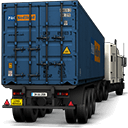 Let’s assume that the container is presented in pristine or well-maintained condition; why might the door not open with ease? Containers are generally either on a trailer / chassis or on the ground, and in both cases the position of the locking gear handles are at an inconvenient height. For best results, the handles should be directly in front of you and at a height that is above the waist and below the shoulders.
Technique is all-important. Start with the two lock rods on the right hand door, lift the handles out of the retainers and rotate them together as far as they will go. This should be more than 90º and rotation beyond 90º often initiates the container door opening process by forcing the cams out of their keepers. Then grasp the vertical locking bars, one in each hand, so that your hands are just below shoulder height and pull back with your body, using your leg muscles rather than you back.
If the door is still stuck, unless specifically advised against doing so (ie. the container is carrying a flexitank or bulk cargo), open the locking bars on the left hand door and then grasp the inner locking rod of both doors and pull back, again using your body not your back. If the door still will not open, ask a colleague to pull on one door while you pull on the other.
Injuries almost always occur at the point frustration takes over and mechanical means are employed – the crow bar or a fork truck. So why will the door not open? Generally, this can be attributed to one of four reasons:
- The container frame is racked so that the door gear will not operate correctly. This may be caused by cargo shifting during transit. Look at the container to make sure that the doors are aligned and level, both top and bottom.
- The hinge pins and blade are seized due to corrosion.
- The door gasket has been damaged and is preventing container door opening. Door gaskets are designed to present two or more fins against the structure or adjacent door. These are generally flexible but when the gasket is damaged, they may become hard or blocked thus jamming the door closed, or preventing it being closed.
- Water has become trapped between the doors and frozen, particularly relevant to refrigerated cargoes, or containers with moisture releasing cargoes in cold weather.
