

Reefer containers, short for refrigerated containers, are a vital innovation that has transformed the way perishable goods are transported and stored worldwide. These specialized containers play a critical role in maintaining the temperature and condition of temperature-sensitive cargo, such as fruits, vegetables, pharmaceuticals, and even certain chemicals. In this deep dive, we will explore the fascinating world of reefer containers, shedding light on how they work and the technology behind them.
The Basics of Reefer Containers
Reefer containers are designed to control temperature and humidity levels within a specific range to preserve the quality and freshness of their contents during transit. Here’s a closer look at how they operate:
Temperature Control:
Reefer containers are equipped with a refrigeration unit that can either cool or heat the interior. This unit maintains the desired temperature set by the operator. The temperature range can typically vary from as low as -30°C (-22°F) to as high as 30°C (86°F), depending on the specific requirements of the cargo.
Insulation and Air Circulation:
To ensure uniform temperature distribution, reefer containers feature high-quality insulation. Additionally, they have an efficient air circulation system that helps distribute cool or warm air evenly throughout the container’s interior. This prevents temperature stratification and ensures consistent conditions for the cargo.
Humidity Control:
Maintaining the right humidity level is crucial for certain cargo types. Reefer containers can control humidity through a combination of features, including air exchange and dehumidification systems. This helps prevent moisture-related issues, such as mold or spoilage.
Advanced Technology
Reefer containers utilize advanced technology to provide precise temperature and humidity control. Here are some key components and features:
Refrigeration Unit:
The heart of a reefer container is its refrigeration unit, which is either integrated into the container or attached as a separate unit. This unit contains a compressor, condenser, evaporator, and a control system. It runs on electricity and can switch between cooling and heating modes as needed.
Telematics and Monitoring:
Many reefer containers are equipped with telematics systems that allow remote monitoring of temperature, humidity, and other conditions. Operators can receive real-time data and alerts, ensuring cargo safety and quality.
Data Logging:
Reefer containers often include data logging capabilities, allowing for the recording of temperature and humidity data during transit. This data can be crucial for verifying that cargo has been transported within the required conditions.
Reefer Container Applications
Reefer containers are indispensable in various industries:
- Agriculture: They transport fruits, vegetables, and other perishable agricultural products to markets worldwide.
- Pharmaceuticals: Reefer containers ensure the safe transport of temperature-sensitive pharmaceuticals and vaccines.
- Seafood: They maintain the freshness of seafood, ensuring it reaches consumers in optimal condition.
- Chemicals: Certain chemicals and products require temperature-controlled transport to maintain their properties.
Challenges and Considerations
While reefer containers are a marvel of modern logistics, they come with challenges. Maintaining temperature and humidity levels during long voyages, power supply reliability, and preventive maintenance are essential considerations.
Additional Reefer Container Information
Reefer containers are a testament to human innovation and our ability to overcome challenges in the world of logistics and transportation. They ensure that fresh produce reaches distant markets, lifesaving medicines remain effective, and temperature-sensitive cargo maintains its integrity. Understanding the technology and operation of reefer containers is vital for industries that rely on them to keep our global supply chains running smoothly and efficiently.
SCS International is now an affiliate reseller of new and used shipping containers/conex boxes, shipping container doors and parts! For more information, please contact us or browse on Amazon/eBay:
- Get a Quote for Shipping Containers
- Shipping Container Doors | Buy on Amazon or eBay
- Shipping Container Lockbox | Buy on Amazon or eBay
- Shipping Container Cam Keepers | Buy on Amazon or eBay
- Shipping Container Lock Rods | Buy on Amazon or eBay
- Shipping Container Door Handles | Buy on Amazon or eBay
- Shipping Container Rubber Gaskets | Buy on Amazon or eBay
- Shipping Container Hinge Pins | Buy on Amazon or eBay
Reefer Containers: The Solution for Shipping Perishable Goods
Reefer containers, also known as refrigerated containers, are specialized containers used for shipping perishable goods, such as food, pharmaceuticals, and flowers. These containers are equipped with temperature-controlled environments, making it possible to transport goods that require specific temperatures and to keep them fresh and safe during transit. In this article, we will explore what reefer containers are, their history, and their role in the modern supply chain.

What are Reefer Containers?
Reefer containers, also known as refrigerated containers, are specialized containers used for transporting perishable goods that require temperature control. These containers are designed to maintain a specific temperature range throughout the shipping process, ensuring that the goods remain fresh and in good condition upon arrival at their destination.
Reefer containers are commonly used to transport a wide variety of perishable goods, including fruits, vegetables, dairy products, meat, seafood, pharmaceuticals, and other temperature-sensitive products. They are typically made of steel and have insulated walls and airtight doors to prevent external heat from entering the container and affecting the internal temperature.
One of the key features of reefer containers is their ability to maintain a consistent temperature range, which is critical for preserving the quality and safety of perishable goods during transit. The temperature range can typically be set anywhere between -30°C to +30°C, depending on the type of goods being transported.
Reefer containers can be powered in a few different ways, including via an onboard generator, external power source, or through the use of a power pack. This allows them to maintain a consistent temperature even during long journeys, while in storage, or during loading and unloading operations.
In addition to their temperature control capabilities, reefer containers are also designed to be durable, secure, and easy to handle. They are often equipped with features such as forklift pockets, tie-down points, and locking mechanisms to ensure that the goods are transported safely and securely.
Reefer containers come in a variety of sizes, ranging from small units that can be transported on trucks to large containers that can be transported on ships. They can be rented or purchased depending on the needs of the customer.
Reefer containers are typically 20 or 40 feet in length and are made from durable materials, such as steel or aluminum, making them capable of withstanding the rigors of international shipping.
Overall, reefer containers play a crucial role in the global supply chain, enabling the safe and efficient transportation of perishable goods around the world. Their ability to maintain a specific temperature range ensures that these goods arrive at their destination in the same condition as when they were loaded, allowing businesses to provide their customers with high-quality, fresh products.
History of Reefer Containers
The use of reefer containers can be traced back to the mid-20th century, when they were first introduced as a solution for shipping perishable goods by sea. Over time, they have become the standard for shipping perishable goods by sea, with millions of containers in use around the world.
The history of reefer containers dates back to the early 20th century when refrigerated transportation was first introduced. Before the advent of reefer containers, perishable goods were transported using insulated boxcars that were fitted with ice bunkers to keep the goods cold.
In the 1930s, companies began experimenting with the use of refrigeration units on trucks, which allowed for the transportation of perishable goods over longer distances. However, it was not until the 1950s that the first reefer containers were developed for use in the shipping industry.
The first reefer containers were developed by American engineer Keith Tantlinger, who had previously worked on the development of containerization. Tantlinger recognized the need for a specialized container that could maintain a consistent temperature range throughout the shipping process, and he developed the first prototype in 1957.
Tantlinger’s design was based on a standard shipping container, but with added insulation and a refrigeration unit. The container was also equipped with a self-contained power supply, which allowed it to maintain a consistent temperature range even when it was not connected to an external power source.
The first reefer containers were put into commercial use in the early 1960s, and they quickly became popular for the transportation of perishable goods such as meat, seafood, and fruits and vegetables. The use of reefer containers revolutionized the shipping industry, allowing for the safe and efficient transportation of perishable goods over long distances and across international borders.
Over the years, reefer containers have continued to evolve and improve. Today’s reefer containers are equipped with advanced temperature control systems, real-time monitoring and tracking capabilities, and other features that allow for the safe and efficient transportation of perishable goods.
Role in the Modern Supply Chain
Reefer containers play a critical role in the modern supply chain. They are used to transport perishable goods from manufacturers and distributors to retailers, and from retailers to customers. With their temperature-controlled environments, reefer containers make it possible to transport goods that require specific temperatures, ensuring that they remain fresh and safe during transit.
In addition, the standardization of reefer containers makes it easier to handle and transport goods, reducing the risk of damage and improving overall efficiency. The containers are also equipped with security features, such as lockable doors and tamper-evident seals, to ensure that the goods inside are protected during transit.
All containers are, the same dimensions, except for length; this has been standardized by the shipping industry, the trucking industry, the railroad industry, and the department of transportation (DOT). This was done in the mid 70’s so that cargo can travel on land surface roadways, byways, and railways. The metal doors on the shipping containers are also standardized.
Reefer Container Door Diagram and Troubleshooting
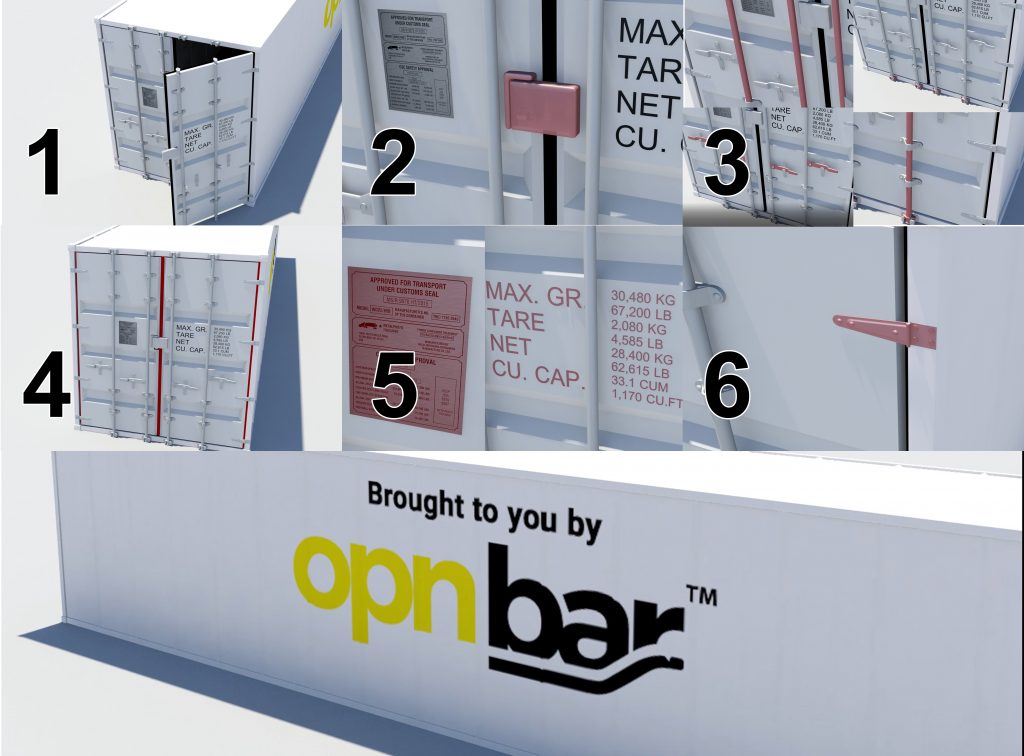
Shipping Container Diagram
1. Doors
Two door leaves are fabricated from two vertical rolled hollow sections and 2 horizontal c section members. The frame is infilled with corrugated steel paneling.
These are normally attached to the rear corner posts each with four drop forged steel hinge blades. The blades allow 270 degree opening which allow the doors to swing back against the container side wall.
(Cargo may shift during transit. Look at the container to make sure that the doors are aligned and level, both top and bottom. In cases where the container frame is racked and the door gear will not operate correctly.)

Shipping Container Door
2. Lockbox
The lock box is a steel box welded to the right hand door which overlaps a staple welded to the left hand door. A padlock, normally type CISA type 285 66 can then be attached inside the lock box through the staple and is then protected from direct attack, hindering attempts to gain entry to the container.

Shipping Container Lockbox
- Shipping Container Lockbox | Buy on Amazon or eBay
3. Lockrods, cam keepers, handles
Each door is fitted with 2-4 vertical lock rods to enable opening, closing and locking of the doors.

Shipping Container Lockrods
- Shipping Container Lock Rods | Buy on Amazon or eBay
At the end of each lock rod (top and bottom) is a cam welded in place which engages with knuckles, also known as cam keepers.

Shipping Container Cam Keepers
- Shipping Container Cam Keepers | Buy on Amazon or eBay
The action of engaging the cams to the keepers forms an anti-racking function.
(In certain cases, often unfortunately too many, contents of the shipping container may have shifted, or containers even dropped, causing shipping container doors and lockrods to warp)
The door handle rotates the lockbar to initiates the door opening process by forcing the cams out of their keepers. Each door handle has a door locking handle retainer that slides over the door handle when in locked position.

Shipping Container Door Handles
- Shipping Container Door Handles | Buy on Amazon or eBay
4. Rubber gaskets
Rubber gaskets are fitted to the container doors during the manufacturing process and prevent water ingress.
(Door gaskets are designed to present two or more fins against the structure or adjacent door. These are generally flexible but when the gasket is damaged, they may become hard or blocked thus jamming the door closed, or preventing it being closed.)

Shipping Container Rubber Gaskets
- Shipping Container Rubber Gaskets | Buy on Amazon or eBay
5. ISO markings and CSC plate
ISO markings and a consolidated data plate allow worldwide intermodal transport when left in place and updated as necessary.

Shipping Container ISO Markings & CSC Plate
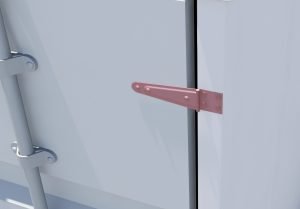
6. Hinge pins
Of course for a door to work, you need hinges.
Shipping Container Hinge Pins
- Shipping Container Hinge Pins | Buy on Amazon or eBay
(In certain cases when doors are difficult to open, hinge pins and blade are seized due to corrosion.)
Find Shipping Container Doors and Parts Here
OPNBar Opening and Closing Tool
Reefer containers use the same type and style of doors and locking bars, which our tool can be used. Because Reefer containers can be pressurized at high elevation, please make sure to use preacautions!
View this post on Instagram
Lengths are as follows: 20′, 40′, 45′, 48′, 50′, 53′. All these containers are globally used to transport cargo. The 53′ length is now, the new standard length.